1. Decide How Your Hockey Jerseys Will Be Used
Before discussing artwork, decide who will wear the jerseys and how they will be used. A youth club ordering game jerseys has different requirements from a beer league team ordering a small batch, while practice jerseys may prioritize simplicity, breathability, and easy reordering. Clarifying the use first prevents you from paying for details the team does not need or choosing a construction that does not suit the season.
Write down the player group, expected quantity, deadline, budget range, and whether the jerseys are for games, practice, tournaments, fundraising, or fan use. Also confirm whether the order includes goalies, because goalie jerseys require a different cut and more room for chest and arm protection. If the roster is still changing, ask the supplier how late names, numbers, and sizes can be finalized without delaying production.
2.Build a Clear Visual Direction
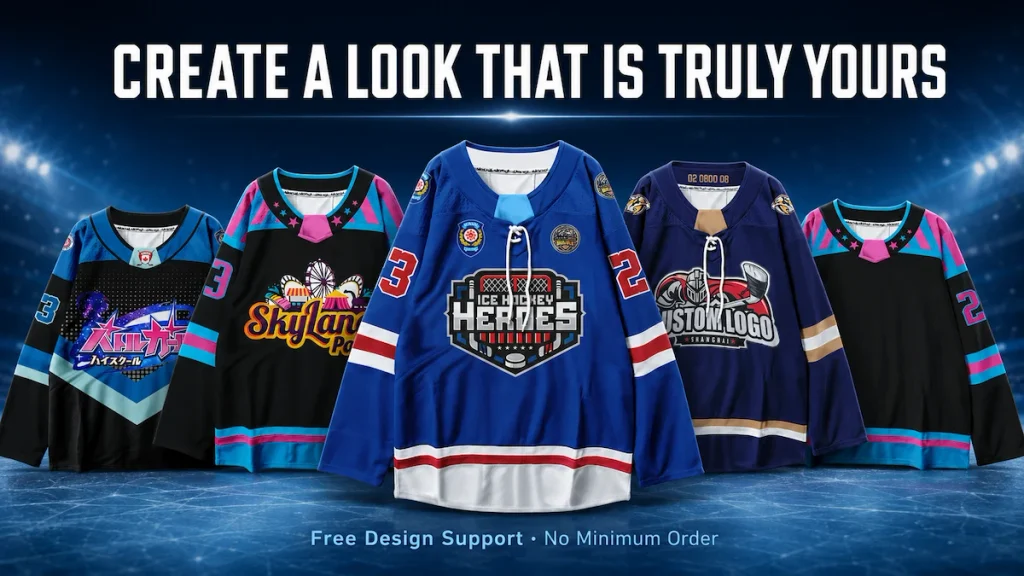
A supplier can create a stronger design when the team provides a clear direction instead of asking for something cool. Start with the team name, primary and secondary colors, logo, and any visual references the players already like. You do not need finished artwork, but you should be able to explain whether the team wants a traditional, modern, aggressive, minimal, or retro look.
Limit the palette to a small group of colors that remain easy to recognize from a distance. Strong contrast between the jersey body, player numbers, and nameplate improves readability on the ice, especially in fast play and low-light rinks. If the team has existing helmets, socks, pants, or gloves, share photos or color references so the new jersey does not look disconnected from the rest of the uniform.
Do not rely on how a color appears on one phone or laptop screen. Screens display color differently, and a digital mockup cannot guarantee an exact physical result without a defined reference. For color-sensitive orders, provide Pantone references when available and ask whether the supplier can produce a printed color swatch or physical sample before bulk production.
3. Prepare the Logo and Artwork
The quality of the final jersey depends partly on the quality of the artwork supplied. Vector files such as AI, EPS, SVG, or editable PDF are normally the best choice because they can be resized without los‐ing sharpness. A clear, high-resolution PNG may still be usable, but a small screenshot, blurry JPEG, or logo copied from social media can create rough edges and inaccurate details.
If the team does not have production-ready artwork, send the cleanest logo available and ask the sup‐plier to confirm whether it needs redrawing. Check spelling, dates, sponsor names, small text, and fine lines before approving the design, because details that look acceptable on a large monitor may become difficult to reproduce on fabric. When sponsors are involved, obtain permission to use their logos and request their official artwork instead of downloading unofficial versions online.
Placement also needs to be decided before production. Common locations include the front chest, shoulders, sleeves, upper back, lower hem, and collar area, but too many marks can make the jersey feel crowded. Give the main team identity visual priority, then add sponsors or secondary graphics without weakening number readability.
4. Choose the Right Fabric and Jersey Weight
Hockey jerseys need enough room and durability for movement, contact, and repeated washing, but heavier does not automatically mean better. A lighter breathable fabric may work well for practice, warm environments, or budget-conscious teams, while a more substantial fabric can provide a pre‐mium hand feel and better structure for game jerseys. The right choice depends on how the team will use the jerseys, the desired appearance, the decoration method, and the budget.
Ask the supplier for fabric weight, stretch, breathability, durability, and washing recommendations in‐stead of choosing from a photo alone. If possible, request close-up photos, short videos, or physical swatches so you can compare texture and thickness. A sample jersey is especially useful when the or‐der is large, the team has strict expectations, or the fabric has not been used before.
At VYM Wear, fabric and construction can be selected according to the team’s use rather than forcing every order into one standard option. The important point is not to choose the most expensive fabric, but to choose a fabric that matches the team’s playing conditions and expectations. A supplier should be able to explain the trade-off clearly instead of simply calling one material better.
5. Select the Decoration Method
The decoration method affects appearance, weight, durability, price, and the level of design freedom. Sublimation is often the most flexible option for full-color custom hockey jerseys because the artwork is transferred into the fabric before the panels are sewn. It can handle gradients, patterns, logos, names, and numbers without adding heavy layers to the jersey.
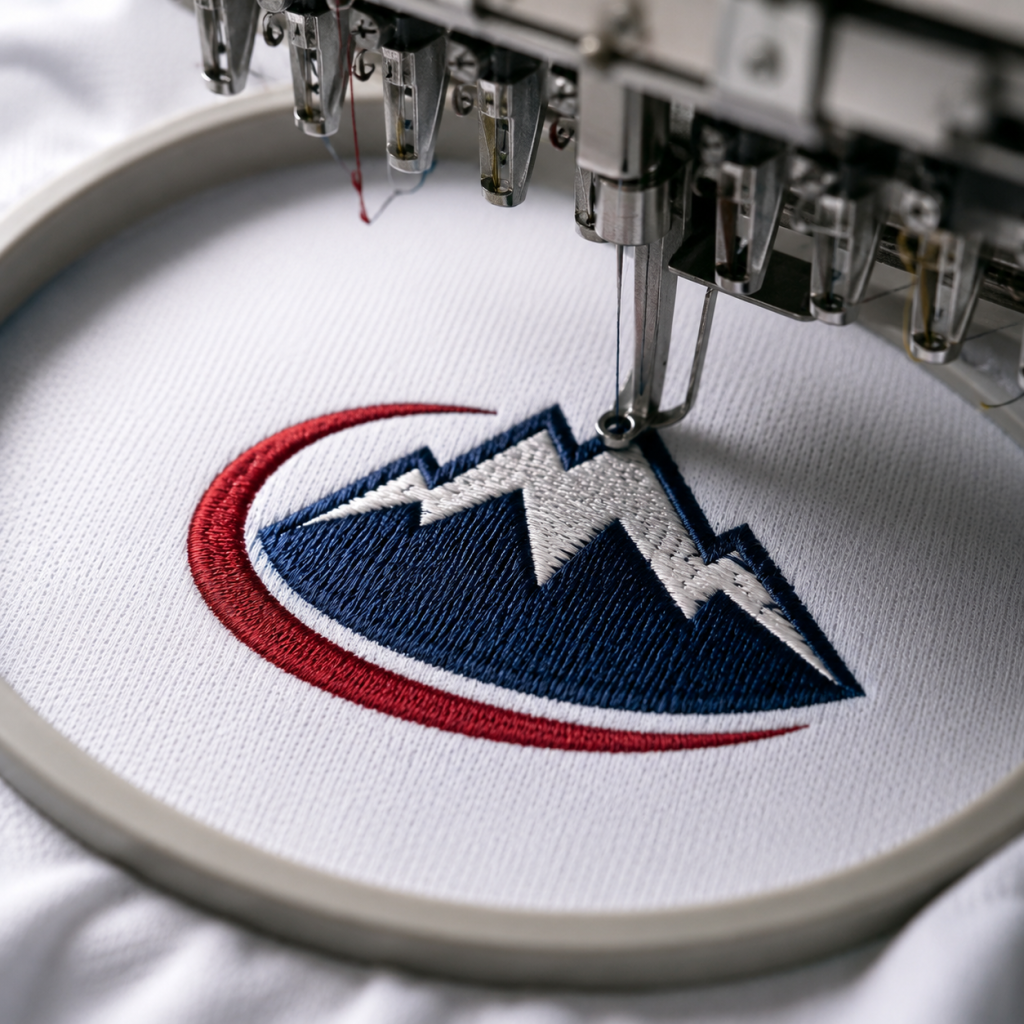
Embroidery creates a raised, textured finish and works well for smaller logos or premium details. Tackle twill uses sewn fabric layers to create the classic dimensional look associated with traditional team uniforms, but it adds weight, labor, and cost. Screen printing can be suitable for simpler graphics and certain order types, although the best method still depends on the design, fabric, quantity, and intended use.
Sublimation
Choose sublimation when the design uses multiple colors, gradients, all-over graphics, or many per‐sonalized names and numbers. Because the design becomes part of the fabric, it does not crack or peel like a surface layer under normal use. The final color can still vary from a screen preview, so color con‐firmation remains importan
Embroidery and Patches
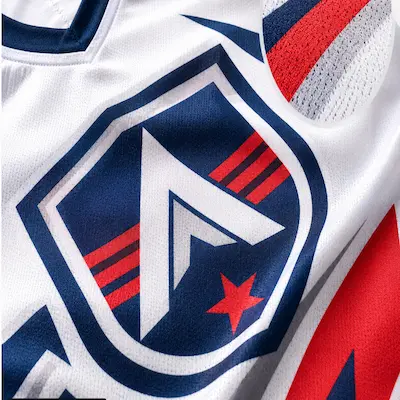
Choose embroidery or patches when the team wants texture, depth, or a premium accent. These methods are often most effective when used selectively rather than covering the entire jersey with heavy decoration. Ask the supplier to confirm how the added weight and stiffness will affect comfort and drape.
Tackle Twill
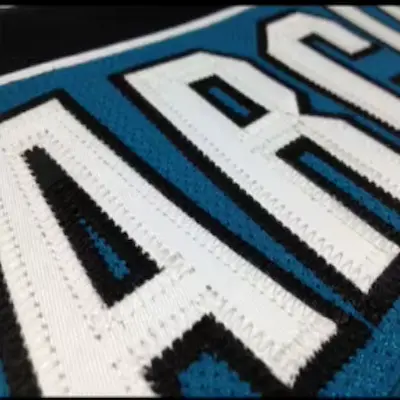
Choose tackle twill when the team wants a traditional layered appearance for crests, names, or numbers. It delivers strong visual impact, but it usually requires more production time and careful sewing than fully sublimated decoration. Make sure the quotation clearly states which elements are twill and which are printed or sublimated.
6. Choose the Correct Player and Goalie Sizes
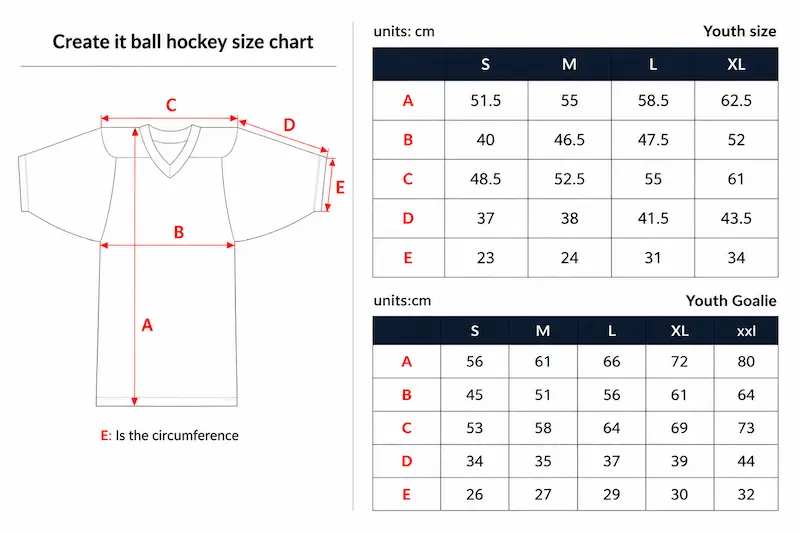
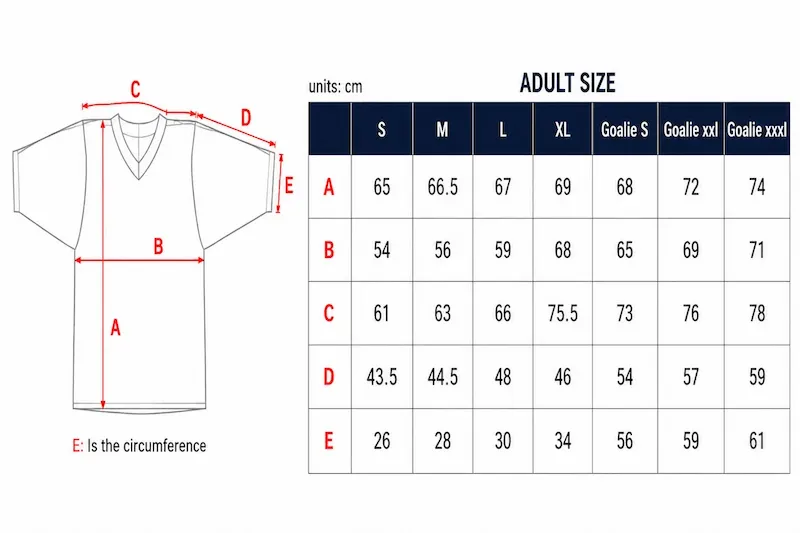
Do not use ordinary T-shirt sizes to order hockey jerseys. Hockey jerseys are designed to fit over shoulder pads, elbow pads, and other protective equipment, and sizing can vary from one supplier to another. Always use the supplier’s own garment measurements and compare them with a jersey that already fits each player well.
The safest method is to lay a well-fitting jersey flat and measure it according to the supplier’s instructions. Compare chest width, body length, sleeve length, and any other measurements shown on the size chart, then consider the player’s protective equipment and fit preference. For youth teams, avoid adding excessive growing room that makes the sleeves or body interfere with play.
Goalie jerseys should be treated as a separate category, not simply ordered several sizes larger. They require extra room through the body and arms for goalie-specific equipment, and the proportions may differ from standard player jerseys. Identify every goalie clearly on the roster and confirm that the supplier is using a goalie pattern before approving the order.
7. Control Names, Numbers, and Roster Information
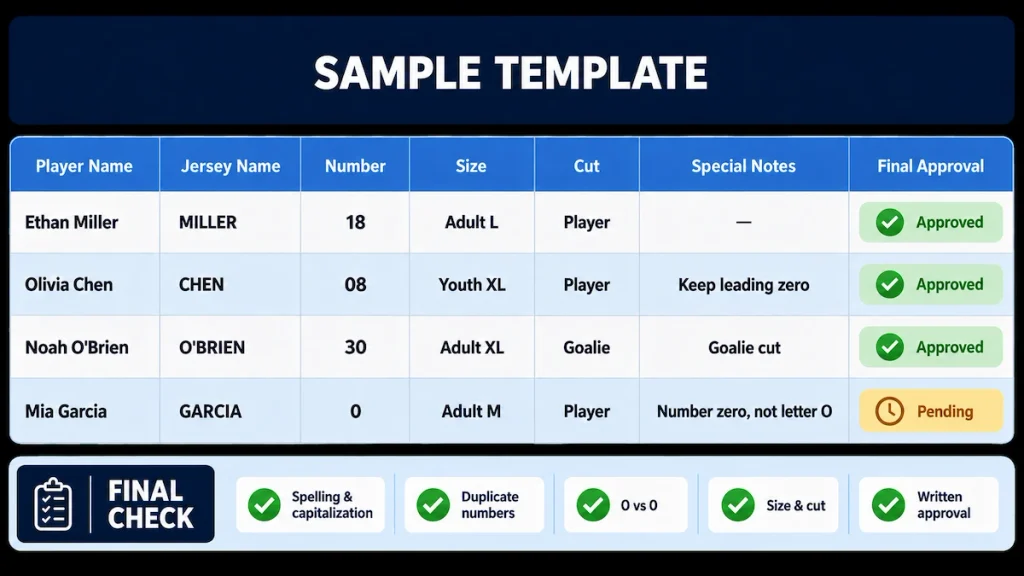
Personalization errors are among the most frustrating problems in a custom team order because one incorrect jersey can delay distribution to the entire team. Do not send names, numbers, and sizes across multiple emails, screenshots, and chat messages. Use one master roster with a separate row for each player and clearly marked columns for player name, jersey name, number, size, cut, and special notes.
Check capitalization, hyphens, accents, duplicated numbers, and characters that can be confused, such as the letter O and the number 0. If a player name is unusually long, ask how the supplier will adjust the lettering before production rather than discovering the change on the finished jersey. Freeze the roster at an agreed deadline, then require one final confirmation document that shows exactly what will be produced.
When a last-minute change is unavoidable, do not assume that editing the roster automatically updates the approved artwork or production file. Send the correction in writing, identify the exact player row, and ask the supplier to confirm the revised version. One source of truth is boring, but boring is exactly what prevents expensive mistakes.
8. Review the Mockup Like a Production Document
A mockup is not merely a picture of what the jersey may look like. It is the document that connects your choices to production, so it should be reviewed with the same care as a purchase order. Check the front, back, sleeves, shoulders, collar, logos, stripes, names, numbers, sponsor marks, and color references.
Do not approve the mockup only because the overall design looks attractive. Zoom in on spelling, alignment, number placement, logo proportions, and the relationship between graphics and seams. Ask whether any artwork may shift slightly during cutting and sewing, especially when stripes or patterns cross multiple panels.
For a large or highly important order, consider approving a physical sample before bulk production. A sample gives the team a chance to inspect fit, fabric, workmanship, color, and decoration in real conditions. It adds time and cost, but it can be cheaper than discovering a preventable problem across an entire order.
9. Confirm Cost, Timeline, and What Starts the Clock
The total price of a custom hockey jersey can change with quantity, fabric, decoration method, person‐alization, sampling, shipping, and delivery location. Ask for a written quotation that states what is in‐cluded rather than comparing only the price per jersey. A low unit price is not useful if artwork, names, numbers, setup, or shipping are added later.
Production time usually does not begin when the first inquiry is sent. It normally begins after the de‐sign, sizes, roster, payment terms, and any required sample or color approval are complete. Ask the supplier to state the approval deadline, production period, shipping method, estimated transit time, and any buffer needed before the team’s first game.
If the delivery date is fixed, work backward from the day the team actually needs the jerseys. Allow time for design revisions, roster collection, sample approval, production, international shipping, cus‐toms delays, and local distribution. A supplier should tell you when the schedule is risky instead of promising an unrealistic date simply to win the order
10. Plan for Reorders Before the First Order Is Finished
Teams change throughout a season, so new players, lost jerseys, and replacement needs are normal. Before placing the initial order, ask whether the supplier keeps the artwork, color references, patterns, and roster records for future reorders. Also confirm whether there is a minimum reorder quantity and whether small reorders may have a different unit price.
Perfect visual matching across production batches cannot always be assumed, especially when fabric lots, inks, or manufacturing conditions change. Keeping approved files and color records reduces variation, but it is still wise to ask the supplier how repeat orders are managed. If you expect several additions, combining them into a planned reorder may save cost and reduce inconsistency.
Final Checklist Before Production
Before approving production, confirm the intended use, quantity, deadline, budget, fabric, decoration method, player sizes, goalie sizes, and final roster. Review every logo, name, number, sponsor mark, color reference, and placement on the approved mockup. Finally, confirm the quotation, payment terms, production start point, shipping method, delivery address, and policy for correcting a supplier-caused production error.
The goal is not to make the ordering process complicated. The goal is to make all important decisions while changes are still inexpensive and easy to make. A clear process protects the team, gives the supplier reliable instructions, and makes it far more likely that every player receives the right jersey on time.
Ready to Customize Your Team’s Hockey Jerseys?
VYM Wear helps teams turn an idea, an existing jersey, or a rough logo into production-ready custom hockey jerseys. We provide design support, size and roster checking, multiple fabric and decoration options, and clear approval steps before production. If you are planning an order, send us your team name, estimated quantity, deadline, logo, and design ideas to receive a recommended solution and quotation.